
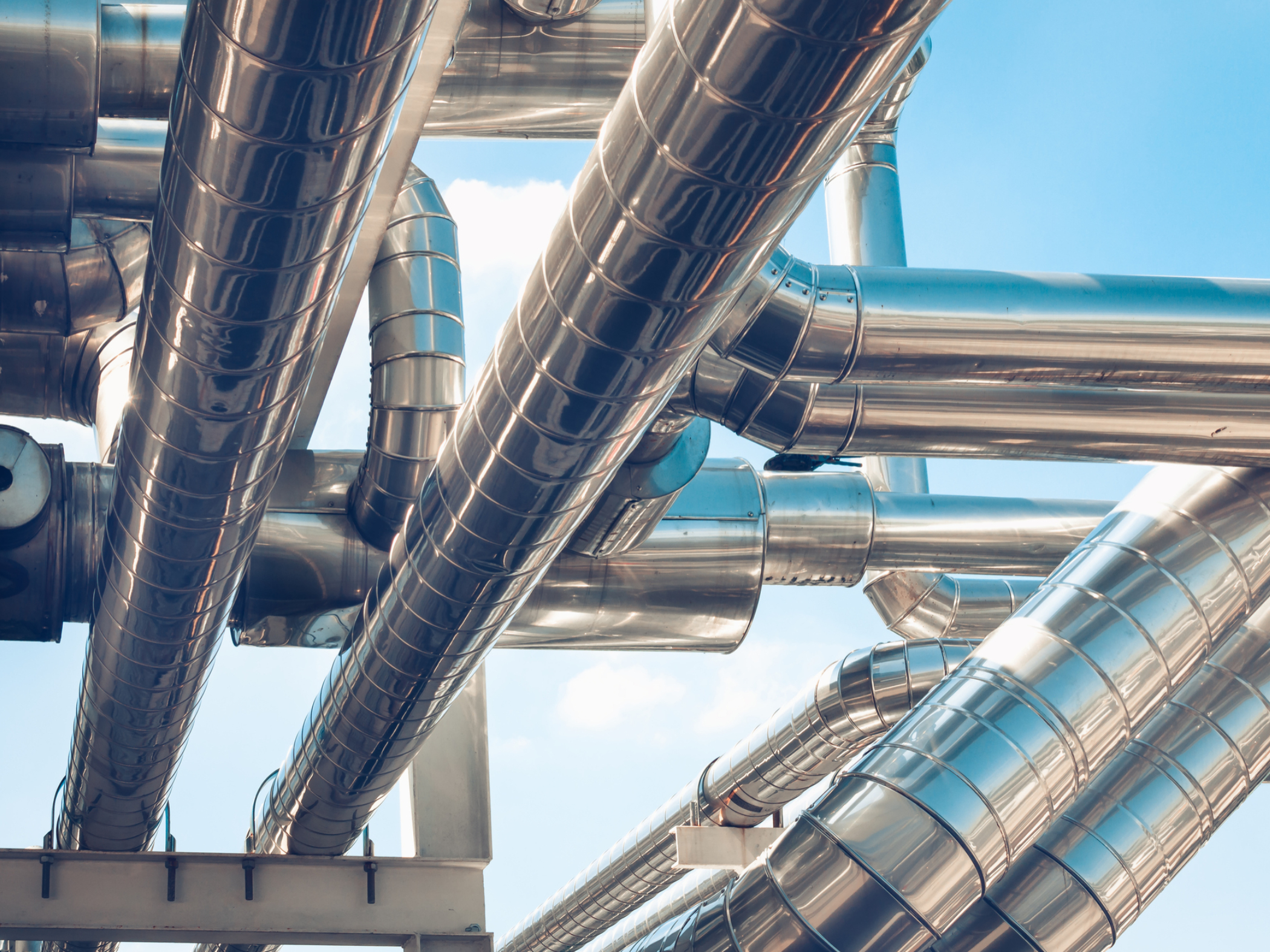
Combined heat and power (CHP) systems integrated with absorption chillers make one cool combo. These chillers take advantage of heat energy from the CHP engine’s exhaust to generate chilled water, which is used for air conditioning or process cooling applications.
Absorption chillers use water as the primary refrigerant. When water is absorbed and then released from a lithium bromide solution, a phase change occurs in a partial vacuum, leading to cooling. This particular absorbent/refrigerant combination is used for air conditioning applications where the chilled water requirement is 40°F and higher.
Lower temperature cooling applications use ammonia as the absorbent. At a food processing plant, this type of chiller was combined with two reciprocating engine generators. The engine waste heat is used to produce 160 tons of 25°F refrigeration, which is supplied directly to a cold room.
Types and capacities
Chillers used in CHP systems typically range in size from 5 to 3,000 refrigeration tons (TR). They come in two configurations:
- Single-stage chillers are often used with reciprocating engines and are driven by hot water (200°F to 240°F) or low-pressure steam (15 psig).
- Two-stage chillers require higher temperature and pressure (350°F, 115 psig) and are often used with combustion turbines.
Exhaust heat (above 740°F) can also be used for either. Although a two-stage chiller has a higher coefficient of performance and capacity, it's usually more expensive and complex than a single-stage unit.
Total installed costs (capital, operating and maintenance) for absorption chillers vary widely, depending on configuration, heat source and other factors. Capital cost per ton of cooling capacity declines as chiller size increases.
Applications abound
Absorption chillers are being combined with CHP in a variety of facility types. For example, at California State University-Fullerton, a 4.5-MW gas turbine is combined with two 1,300-ton chillers to provide power and cooling for the campus. Nearly 75% of the turbine's waste heat is recovered for other purposes. At Syracuse University’s data center, 12 65-kW microturbines and two 150-ton exhaust gas-fired chillers provide 780 kW of power and 300 tons of refrigeration for cooling the facility.
The U.S. Army’s Fort Knox received a CHP award from the U.S. Environmental Protection Agency for its installation of a 600-ton absorption chiller and a 2-MW CHP system at its Human Resources Command Data Center. The power usage effectiveness (PUE) was reduced from the original 4.0 when the center opened to 1.47 per month.
To further reduce the data center’s PUE, an existing microgrid power generation substation equipped with CHP capabilities is also used. Energy savings were about $143,000 per year, a 35% decrease.
Follow the lead of these innovative organizations and consider how CHP systems with absorption chillers can save you energy and money while improving your operations.