
Temperature control is essential to ensure that steam is delivered at the correct process pressure and temperature, increasing efficiency, preventing equipment damage and product quality issues caused by overheating or insufficient heat transfer. Also, precise temperature control reduces fuel consumption and ensures safe operation by preventing dangerous pressure buildup or thermal stress on piping and equipment.
Self-acting temperature controls are beneficial in steam systems because they operate without the need for external power sources. They also provide a simple, robust and low-maintenance solution for maintaining precise temperature control, reducing the risk of failure associated with more complex electronic or pneumatic control systems.
How they work
Self-acting temperature controls work by using a sealed thermostatic system filled with a temperature-sensitive fluid. When the controlled medium reaches a set temperature, the fluid expands, generating hydraulic pressure that acts on a bellows or diaphragm, which in turn moves a valve to reduce or shut off steam flow. As the temperature drops below the set point, the fluid contracts, reducing the hydraulic pressure and allowing the valve to reopen, admitting more steam.
This continuous self-regulating process requires no external power source, electricity or instrumentation, as the system uses the energy of the process itself to maintain precise temperature control automatically.
Three configurations
Control valves and the associated sensors are typically incorporated into self-acting temperature control systems using three common configurations: adjustment at the sensor, adjustment at the actuator and remote adjustment.
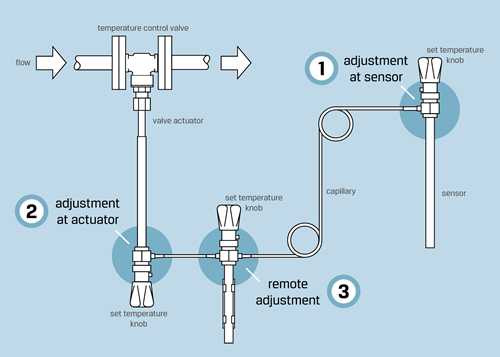
These three configurations can also incorporate a high-limit cut-out unit, which prevents overheating of the process. This device is installed on the control valve and shuts off the flow of the heating medium in the pipe when the temperature goes above the limit. High-limit devices are used with two-port valves (normally open and normally closed) and three-port valves. Applications include domestic hot water and industrial processes.
Benefits and applications
Self-acting temperature controls provide numerous advantages for steam systems compared to pneumatic or electronic controls:
- Low cost. They offer a budget-friendly and straightforward method to stabilize temperatures in constant-demand systems.
- Self-powered. They are fully self-actuated, operating independently of plant power outages or complex electronic control panels.
- Robust and durable. They are highly resistant to harsh, corrosive or hazardous environments where electrical systems might fail.
Because they offer reliable, maintenance-free operation in harsh environments, self-acting temperature controls are particularly well-suited to applications where external power sources may not be readily available or practical. These include:
- Regulating temperatures in heat exchangers and process heating vessels.
- Regulating steam supply in commercial laundries and parts-washing equipment.
- Controlling steam coils in HVAC systems to heat air for building spaces or industrial drying processes.
- Ensuring consistent temperatures for steam sterilization in healthcare facilities and food processing.
Compared to electronic models, self-acting temperature controls do have limited adjustability, a limited operating range and can handle only one control point at a time. They also lack the ability to integrate with modern building management systems. Work with a trusted vendor to decide whether self-acting controls are right for your application.